Nature-Positive Development: Aligning Policy, Finance, and Design for Resilient Communities
Friday, October 23, 2026 11:30 AM to 12:30 PM · 1 hr. (US/Eastern)
Information
"Learn how policy, finance, and design across the built environment are influencing nature-positive development strategies. At its core, nature positive is about halting and reversing nature loss by rethinking how development performs over time. Buildings, landscapes, infrastructure, and cities are increasingly expected to restore ecological function, strengthen resilience, support public health, and adapt to long-term climate pressures. What began as a biodiversity conversation is increasingly influencing policy, investment, and risk decisions across the built environment.
This session examines how LEED, SITES, and related frameworks support biodiversity, resilience, ecosystem services, and public health while addressing implementation opportunities and barriers across sectors and scales. Speakers from municipal government, finance, regenerative design, and certification will discuss how nature-based strategies are influencing project planning, financing, and delivery.
The discussion connects market pressures to on-the-ground realities, including:
• Biodiversity disclosure frameworks such as the Taskforce on Nature-related Financial Disclosures (TNFD)
• Resilience, risk, and insurability considerations
• Climate adaptation policy and public-sector requirements
• Demand for measurable environmental performance
USGBC will frame how nature-positive strategies integrate across LEED, SITES, and LEED for Cities, examining how these frameworks support resilience, public health, landscape performance, and ecological outcomes across scales. The discussion will also address where stronger alignment and clearer implementation pathways may still be needed.
Case studies and audience engagement will ground the discussion in practice. Attendees will leave with a clearer understanding of the forces driving nature-positive development, how those pressures are reshaping decision-making, and what it takes across policy, finance, design practice, and certification systems to scale implementation."
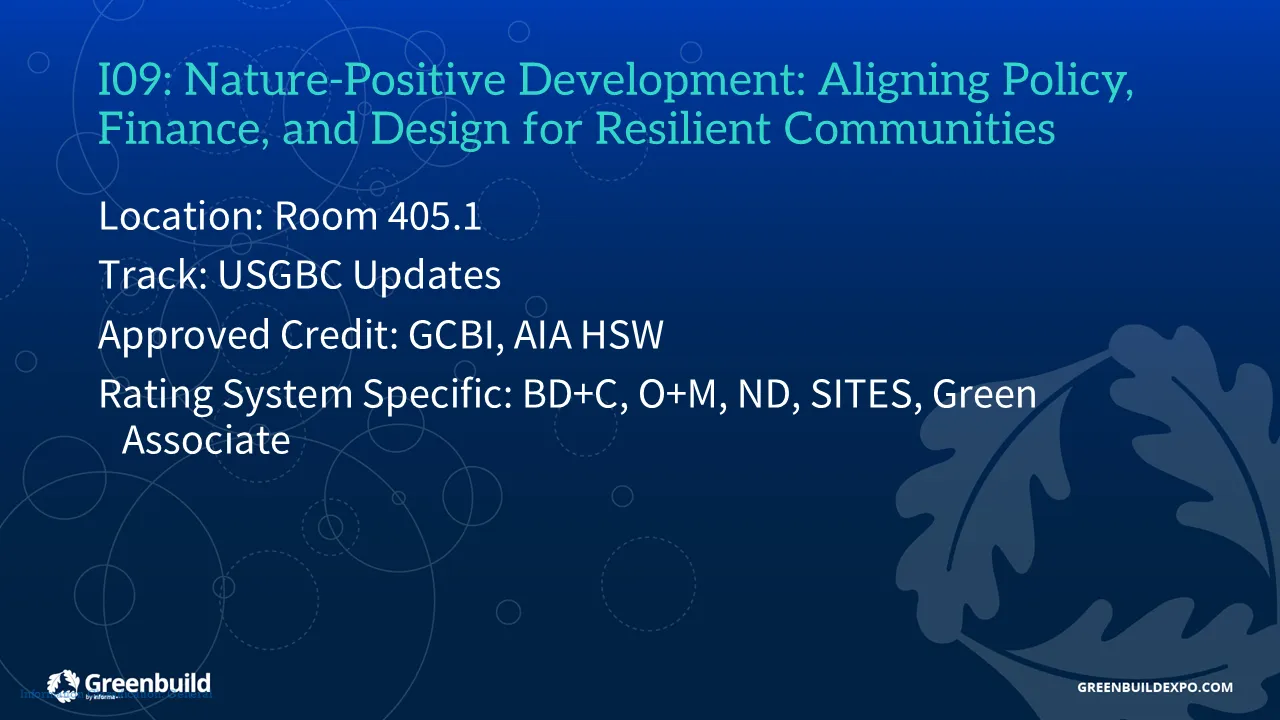
This session examines how LEED, SITES, and related frameworks support biodiversity, resilience, ecosystem services, and public health while addressing implementation opportunities and barriers across sectors and scales. Speakers from municipal government, finance, regenerative design, and certification will discuss how nature-based strategies are influencing project planning, financing, and delivery.
The discussion connects market pressures to on-the-ground realities, including:
• Biodiversity disclosure frameworks such as the Taskforce on Nature-related Financial Disclosures (TNFD)
• Resilience, risk, and insurability considerations
• Climate adaptation policy and public-sector requirements
• Demand for measurable environmental performance
USGBC will frame how nature-positive strategies integrate across LEED, SITES, and LEED for Cities, examining how these frameworks support resilience, public health, landscape performance, and ecological outcomes across scales. The discussion will also address where stronger alignment and clearer implementation pathways may still be needed.
Case studies and audience engagement will ground the discussion in practice. Attendees will leave with a clearer understanding of the forces driving nature-positive development, how those pressures are reshaping decision-making, and what it takes across policy, finance, design practice, and certification systems to scale implementation."
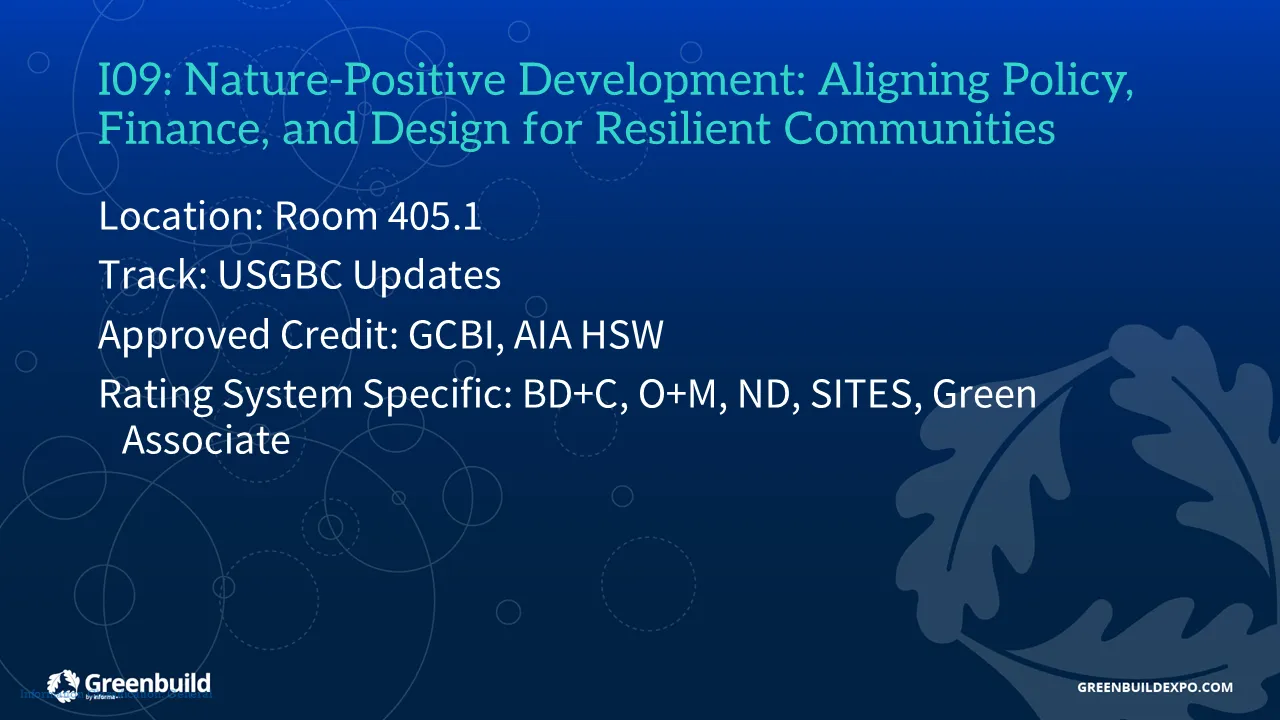
Track
USGBC Updates
Learning Objective #1
Identify the market forces driving nature-positive development, including biodiversity policy, resilience planning, investor expectations, insurance risk, and disclosure frameworks.
Learning Objective #2
Describe how USGBC frameworks (LEED, SITES, and LEED for Cities) support nature-positive strategies across buildings, sites, campuses, and cities, and how they contribute to ecological performance, public health, and resilience outcomes.
Learning Objective #3
Examine how policy, finance, design practice, and certification systems influence the planning, financing, delivery, and long-term performance of nature-positive development strategies.
Learning Objective #4
Evaluate implementation challenges, barriers, and opportunities affecting the adoption of nature-positive development strategies across sectors and scales.